Case 24 — Vomiting
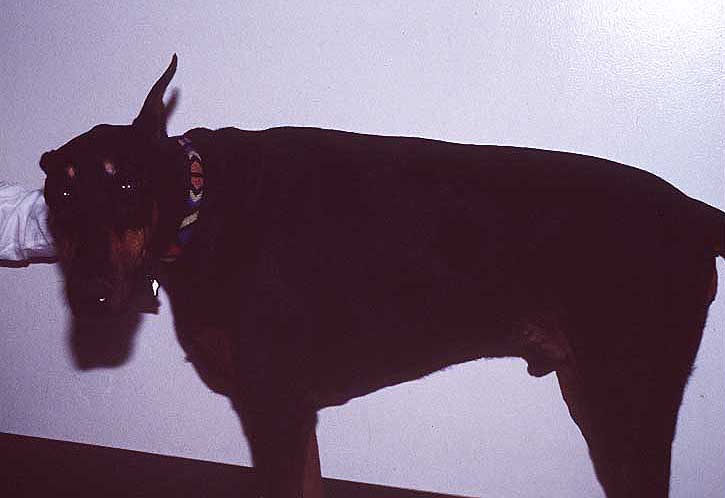
Primary clinician: Darcy Adin, DVM & Chris Adin, DVM, DACVIM (Cardiology)
Supervising clinician: Mark D. Kittleson, DVM, PhD, DACVIM (Cardiology)
Signalment
- Species: Canine
- Breed: Doberman Pinscher
- Age: 6 years
- Sex: Male castrated
- Name: Nitro
Presenting Complaint
- Vomiting
Pertinent History
- Nitro was treated for pancreatitis by the referring DVM last week. He received fluids and Baytril. He recovered and was getting better when he started vomiting the last few days.
- The owner thinks that maybe he introduced the regular dog food too soon and should have kept him on cottage cheese and rice longer.
- Yesterday he began vomiting more and became very lethargic. He was taken to the referring DVM. Because the heart sounds were muffled, chest x-rays were taken which showed an enlarged cardiac silhouette.
- The referring DVM gave him 1 L Lactated Ringer’s Solution IV and Nitro improved although he still appeared slightly shocky.
- He was referred to the VMTH.
- Blood work was done last week. The owner said the white cell count was elevated and the liver enzymes showed evidence of toxicity.
Physical Examination
- General: QAR, moderately dehydrated, presents in sternal recumbency, reluctant/unable to stand.
- HR = 200; RR = 30.
- Integument: Full coat, somewhat dry. No cutaneous masses.
- EENT: Eyes — clear. Ears — clean. Tonsils in crypts.
- Musculoskeletal: Well muscled, BCS 6/9.
- Cardiovascular: Mm pale; muffled heart sounds; pulses decrease on inspiration and increase on expiration; no murmur auscultated; rhythm is regular but tachycardic; jugular vein distension noted.
- Respiratory: Lungs clear in all fields.
- GI/GU: No ascites appreciated; smooth gut loops; no palpable masses. Kidneys/bladder not palpable.
- No peripheral lymphadenopathy.
Problems
- Abnormal pulses
- Muffled heart sounds
- Jugular vein distension
- Tachycardia
- 2–3/6 systolic heart murmur