Case 14 — Case Discussion
This dog has frequent episodes of sinus arrest on its ECG. Sinus arrest is caused either by a dying sinus node (Sick Sinus Syndrome) or markedly increased vagal tone. Since there was no response to atropine, a vagally mediated arrhythmia was ruled out. Consequently, sick sinus syndrome was the diagnosis. Because the dog was having frequent and long periods of sinus arrest and was showing clinical signs compatible with weakness caused by cessation of blood flow (stumbling in the caudal limbs), pacemaker implantation was warranted. The owner agreed to proceed after being informed of possible complications.
Houdi also had moderate mitral regurgitation with a moderately enlarged left atrium. Moderate mitral regurgitation was not a contraindication to pacemaker implantation.
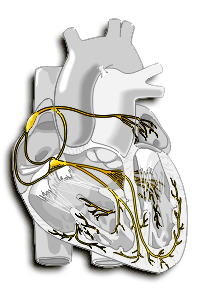
Houdi was atropinized and taken into a fluoroscopy room. A catheter introducer was placed in the left lateral saphenous vein and a temporary pacing lead advanced into the right ventricle. The heart was paced at 100 bpm. To document sinus node dysfunction, sinus node recovery time was measured by pacing for several minutes then turning off the pacemaker. In a normal dog, recovery is very short. In a dog with a diseased sinus node, the cells undergo overdrive suppression and take much longer to recover.


About half the time recovery was normal; the other half showed prolonged recovery. This sinus node apparently has some cells that can still respond normally at times but are clearly diseased enough that they cannot respond normally at all times.