Case 20 — Case Discussion
Stubs presented with clinical signs consistent with and radiographic evidence of left heart failure. The radiographs showed cardiomegaly with a markedly enlarged left atrium particularly noticeable on the lateral view, where the left mainstem bronchus was markedly elevated. The ECG showed left ventricular enlargement (R wave ~3 mV in lead II).
The echocardiograms demonstrated two combined problems — mitral stenosis and mitral regurgitation. The mitral stenosis was seen as restricted leaflet motion in diastole on 2D echo and a turbulent diastolic jet on color flow Doppler. The pulsed wave Doppler showed a peak diastolic velocity of 1.75–2 m/s (PG 12–16 mmHg), at least moderate for a diastolic gradient. Normal left atrial pressure is <10 mmHg; pulmonary edema starts at ~20 mmHg, so this gradient alone raises LA pressure to at least 20–25 mmHg.
Stubs also had mitral regurgitation. The systolic MR jet velocity was only 3.72 m/s (PG 55 mmHg) — much less than the expected ~100 mmHg. This could be due to decreased LV systolic pressure (hypotension) or markedly increased LA pressure. With moderate to severe pulmonary edema, mean LA pressure was probably ~30 mmHg, with peak LA pressure around 45 mmHg. The PG of 55 mmHg would give a LV systolic pressure of ~100 mmHg (low end of normal). Both functional problems were due to a congenitally abnormal mitral valve — mitral valve dysplasia. An abnormal band of tissue beneath the mitral valve may also have contributed.
Discharge Instructions
- Stubs has a congenital heart defect called mitral valve dysplasia — a malformed valve causing a very large leak and a stenosis (obstruction to inflow). His heart is very enlarged and he is in congestive heart failure. Surgery to fix the valve is not possible, so medical therapy will be used. His prognosis is very poor given the severity at such a young age.
- Lasix (furosemide) 12.5 mg (1 tablet) twice daily. Enalapril 2.5 mg (½ tablet) twice daily.
- Monitor resting respiratory rate (<30 breaths/minute is normal). Count for 15 seconds and multiply by four. Call if it increases or stays persistently high.
- Watch for medication side effects (anorexia, lethargy, vomiting, diarrhea).
Follow-Up
Four Months Later
Stubs’ owner indicated in a voice mail that they hadn’t changed his medication dose and that he was doing very well.
Three Years Later
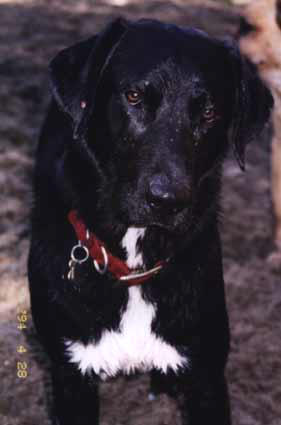
Amazingly, Stubs is still alive and doing very well. He currently weighs 56 pounds (similar to his father at 60 pounds; one brother weighs 80 pounds). His exercise capabilities appear quite good — in the summer he swims every day and loves to dig holes in the sand on the beach. He seems to know his limits, playing hard then taking a break before going back at it again. He is still on the same medications (Lasix 25 mg BID; lisinopril 10 mg BID; digoxin 0.375 mg SID) and his owners don’t take him to higher elevation during the summer. Although he is still his owners’ “special child,” he appears normal in all respects.