Case 33 — Cough
Primary clinician: Sarah Miller, DVM, DACVIM (Cardiology)
Supervising clinician: Mark D. Kittleson, DVM, PhD, DACVIM (Cardiology)
Signalment
- Species: Canine
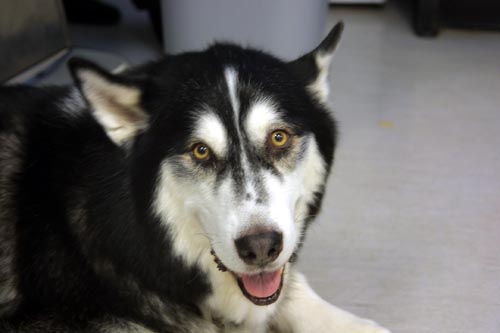
- Breed: Husky
- Age: 7 years
- Sex: Male castrated
- Weight: 29 kg
- Name: Fisher
Presenting Complaint
- Cough
Pertinent History
- Fisher was presented to the VMTH Cardiology Service for evaluation of possible heartworm infection.
- According to the owner, Fisher started having clinical signs one to two months ago. He has been coughing, retching, and lethargic and has had labored breathing especially in the last three weeks.
- Four weeks ago he had an episode of collapse while playing fetch. It took him approximately ten minutes to recover from the collapse, but he was conscious and responsive during the episode.
- Fisher was taken to his veterinarian 3 days ago where thoracic radiographs, an ECG, CBC, chemistry panel, urinalysis and heartworm test were performed.
- Thoracic radiographs showed dilated pulmonary arteries and other radiopaque areas in the lungs.
- ECG did not show an arrhythmia, but there were wide T waves. CBC showed a regenerative anemia (HCT=31%) and eosinophilia of 2,992/uL. His chemistry panel indicated hypoalbuminemia (2.1) and an increased globulin (5.4). Urinalysis showed SG=1.023 and 3+ proteinuria.
- Fisher's heartworm antigen test was performed by IDEXX and came back as weak positive. He was also positive for microfilariae.
- Fisher is current on his vaccinations except Bordetella and is not on any current medications.
- He was given IV fluids and IV Cefazolin TID (dose unknown) at the referring veterinarian for three days.
- Fisher still has a good appetite and is fed Sensible Choice reduced kibble (Lamb and Rice) along with dog biscuits.
- He was tested for heartworm in 2001 and was negative. He was started on Interceptor, but he apparently had an allergic reaction to it and would vomit it up every time it was administered. He has not been on any heartworm preventative since that time.
- Fisher has not had any vomiting or diarrhea recently but has been having slightly looser stools.
- There are three other dogs in the household that are all relatively healthy and are all on heartworm preventative.
- He lives in Shingle Springs, CA in the foothills of the Sierra Nevada mountains, a region known to be endemic for heartworm.
Physical Examination
- GEN: QARH, T=101.6, P=140, R=pant; MM pink/moist, CRT<2s.
- INTEG: Clean, shiny coat, no areas of alopecia; shaved areas over both cephalic veins; catheter still in place in right cephalic.
- EENT: Eyes — cornea clear OU, sclera white OU, no conjunctival hyperemia, no ocular discharge. Ears — clean, no odor. Nose — wet, no discharge. Throat/Teeth — mild dental calculus, no oral ulcers or masses noted.
- MS: No obvious abnormalities, coordinated gait, ambulatory.
- CV: No heart murmur ausculted; no arrhythmia detected; difficult to auscult; strong, synchronous femoral pulses.
- RESP: No harsh lung sounds, panting heavily.
- GI: Doughy abdomen, hepatomegaly and splenomegaly detected on palpation. Feces appeared dark and tarry on walk.
- GU: No discharge from prepuce; smooth bladder palpated.
- NS: No obvious abnormalities; complete neurological examination not performed.
- LN: Submandibular, prescapular and popliteal all <1.5cm.
Problems
- Heartworm infection
- Proteinuria presumed secondary glomerulonephritis
- Regenerative anemia
- Eosinophilia
- Melena