Case 14 — Material Gathered After Pacemaker Implantation

ECG Taken After Pacemaker Implantation

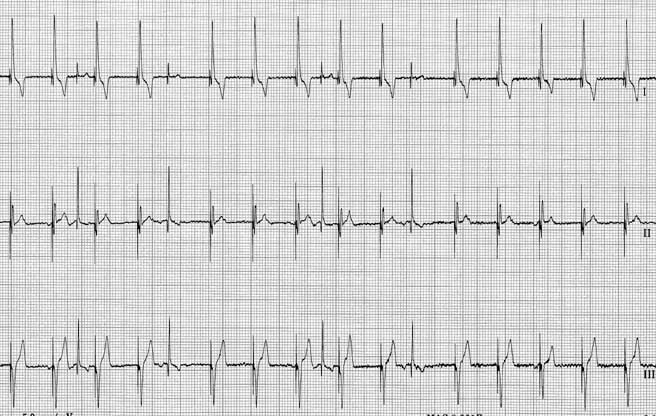
ECG after permanent pacemaker implantation at 25 mm/second. A spike precedes each QRS complex. There is exactly 0.6 seconds (15 mm) between each spike, meaning the pacemaker rate is set at exactly 100 bpm.
Post-implantation ECG (25 mm/s). Pacemaker spikes precede each QRS at exactly 0.6-second intervals (100 bpm).

Thoracic Radiographs Taken After Pacemaker Implantation
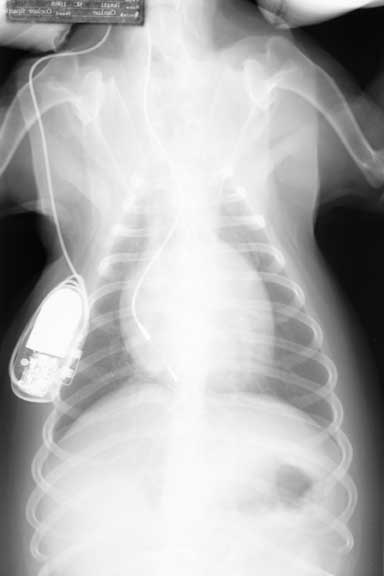
DV thoracic radiograph taken one day after pacemaker implantation showing the lead and generator well-positioned.
Post-implantation DV radiograph.
Lateral thoracic radiograph showing the pacemaker lead coursing from the heart up the cranial vena cava to the jugular vein and then subcutaneously back to the lateral thorax where the generator is positioned.
Post-implantation lateral radiograph. Lead courses from the heart through the cranial vena cava to the jugular, then subcutaneously to the generator on the lateral thorax.

ECG Taken That Evening

ECG recorded later the same day showing the VVI pacemaker intermittently failing to sense spontaneous sinus beats. Some spontaneous beats are sensed and reset the pacemaker correctly, while others are not sensed and the pacemaker continues at its set rate. The sensitivity setting was adjusted to resolve this issue.
Evening ECG. The VVI pacemaker intermittently fails to sense spontaneous sinus beats. Some beats are sensed correctly (6th complex) while others are not (3rd complex). The sensitivity setting was adjusted to resolve this.

This VVI pacemaker paces the ventricle, senses ventricular depolarizations, and should be inhibited by sensed beats. Spontaneous beats that were sensed correctly reset the pacemaker (followed by a 0.6-second pause). Unsensed beats did not interrupt the pacemaker rhythm. The sensitivity setting was changed via an external programming device and the problem resolved.

Houdi has gone on to do well with his pacemaker. Unfortunately, he also has a glomerulonephropathy that continues to cause problems. ACE inhibitors actually help protein loss in glomerulonephropathies by decreasing intraglomerular pressure, so it may have been a mistake to discontinue the ACE inhibitor.