Case 21 — Subsequent Examinations
Two Days After Discharge
Clinically better. Echo: persistent spontaneous contrast in LA. PT 9.7 sec (normal). Warfarin increased to 0.75 mg PO SID. Heparin discontinued.
Five Days After Discharge
Echo: persistent spontaneous contrast. PT 13.4 sec (longer but still normal). Continue current warfarin dose; retest in a couple of days.
Ten Days After Discharge
Echo: a very large clot in the left auricle. PT 98 seconds (severely prolonged). The clot will likely break free and cause sudden death. Warfarin stopped since it has not effectively prevented thrombus formation despite severely prolonging PT.
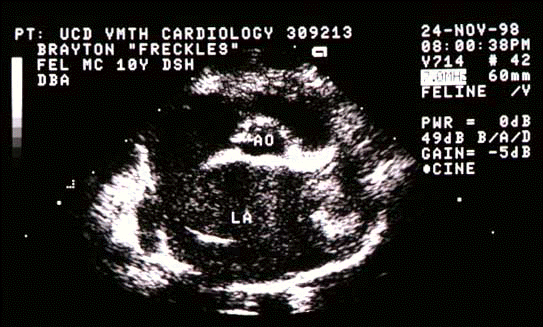
Two and a Half Weeks After Discharge
PT 11.6 sec (normal). LA thrombus remains. Mild pericardial and pleural effusion. Pleural effusion likely from CHF. Lasix increased to 12.5 mg PO BID. Aspirin 81 mg PO q3d started.
Three and a Half Weeks After Discharge
Weight loss, lethargy, poor appetite — possibly from aspirin. Persistent spontaneous contrast and LA thrombus. Pleurocentesis: 50 ml pink/chylous effusion. Owner took Freckles home; aspirin stopped. Three days later: Freckles rebounded — eating, drinking, very active.
Four and a Half Weeks After Discharge
Eating well, more active, but increased respiratory effort. Thoracocentesis: 220 ml chylous fluid. LA thrombus unchanged.
Seven Weeks After Discharge
On atenolol 6.25 mg BID, enalapril 1.25 mg SID, Lasix 12.5 mg BID. Slightly increased respiratory effort. LA thrombus unchanged but appears mobile. Pleurocentesis: 110 ml serosanguinous fluid. Lasix increased to 18.75 mg BID.
Ten Weeks After Discharge
No thrombus present in LA today. No signs of thromboembolism. 140 ml pleural fluid removed.
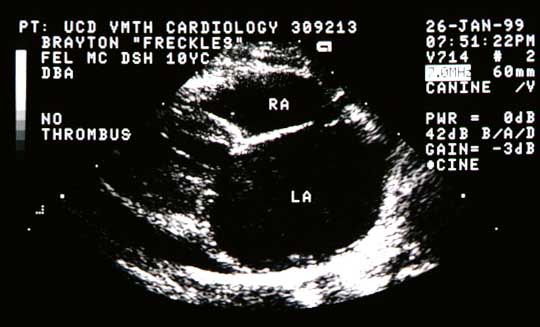
Eleven Weeks After Discharge
Dehydrated, not eating well. Lasix discontinued for 2 days; Freckles ate well. New thrombus visualized in LA. Severe pleural effusion: 175 ml chylous fluid removed. Hypokalemia (K 2.8); started Tumil-K. Mild azotemia unchanged.
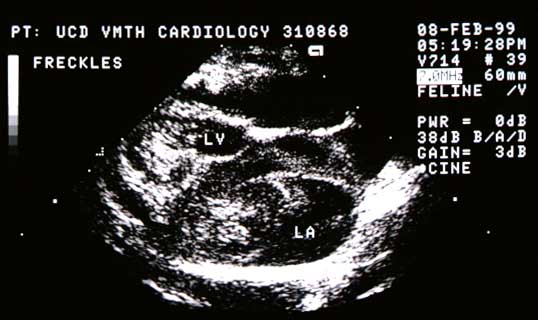
Video of dense, swirling spontaneous contrast in the left atrium and a thrombus in the left auricle from a different cat
Twelve Weeks After Discharge
Tachypneic, depressed, cyanotic MM, cachectic. HR 160 irregularly irregular. 220 ml chylous effusion removed. Improved after drainage. K 3.6 (low normal).
Thirteen Weeks After Discharge
Lasix increased to 18.75 mg BID again. Doing well at home. Eupneic. 105 ml chylous effusion drained. LA thrombus large and mobile.
Fourteen Weeks After Discharge
Weekly thoracocentesis. LA thrombus appears subjectively larger. 140 ml chylous effusion removed.
Fifteen Weeks After Discharge
HR 150, irregularly irregular. Very thin. 160 ml chylous effusion removed. LA thrombus unchanged.
Sixteen Weeks After Discharge
Phone conversation: Freckles was doing well. The owner went to the store and when she came home he was dead, lying peacefully in the hallway (sudden death). The owner buried Freckles in the back yard.
Summary
Freckles lived for four months with severe cardiac disease and a large left atrial thrombus that came and went. No one expected him to live this long, but he, his owner, and Dr. Adin persevered. His outcome should in no way be used to predict the outcome of any other cat with the same disease processes. Many cats with saddle thromboembolism die soon after, and almost all cats with a large left atrial thrombus do poorly. Freckles was a “miracle” cat who defied the odds.