Case 9 — Case Discussion
Bingo was diagnosed with severe mitral regurgitation secondary to myxomatous mitral valve degeneration. This diagnosis was made based on his radiographically and echocardiographically enlarged left atrium, the appearance of his mitral valve on echocardiography, the color flow Doppler exam, his history, and his signalment. Although endocarditis of the mitral valve could not be completely ruled out, his valve anatomy was not typical of endocarditis and he had no history suggestive of endocarditis (e.g., fever, anorexia, evidence of thromboembolic complications). In addition, he was a small breed dog. Most bacterial endocarditis is diagnosed in large breed dogs while most myxomatous degeneration is seen in small breed dogs. At least part of Bingo’s severe leak was apparently due to ruptured chordae tendineae as evidenced by his flail mitral valve leaflets, another characteristic of myxomatous degeneration (since chordae tendineae also undergo this type of degeneration in concert with the leaflets). Because of his severe leak, Bingo had developed quite severe left heart failure manifested as pulmonary edema. Despite his severe radiographic appearance, he was clinically stable enough to be treated on an outpatient basis.
Bingo also had supraventricular premature beats that most likely originated from his enlarged and diseased left atrium. They occurred about 5 times a minute and depolarized at a rate of about 200 beats/minute. Although these premature beats may be a harbinger of developing atrial fibrillation in the future, there is no proven means of preventing this or delaying its onset. Consequently, it was decided not to treat his arrhythmia. The only other possible ECG abnormality was the R wave in lead II being right at 2.5 mV in height, the upper end of normal. This dog did have left ventricular hypertrophy.
Follow-Up
Furosemide (40 mg IM) was administered to Bingo while he was in our clinic. He was then sent home on 25 mg furosemide q8 hours PO for the first two days followed by 25 mg q12 hours PO. He was also started on enalapril (5 mg q12 hours PO). The owners were instructed to count his respiratory rate each day when he was lying down and relaxed or asleep. We told them that we wanted it to decrease to less than 30 breaths/minute (normal). They were also instructed to return five days later for a recheck. At that visit, they reported that his coughing had decreased by 75% but that his respiratory rate was still around 50 breaths/minute. Because he had been administered enalapril, blood was taken to measure BUN and serum creatinine concentration. They were well within normal limits, as were his serum electrolyte concentrations.
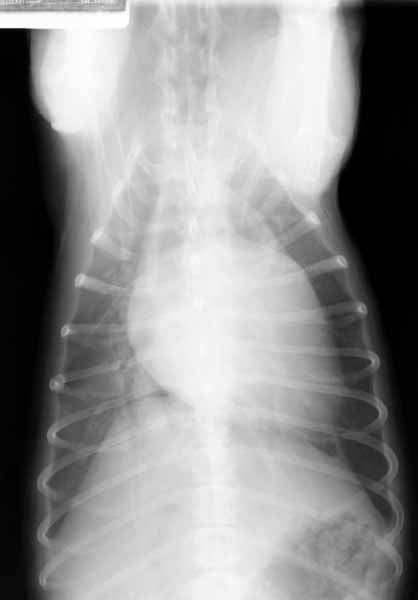
Recheck Radiographs
DV
Right Lateral
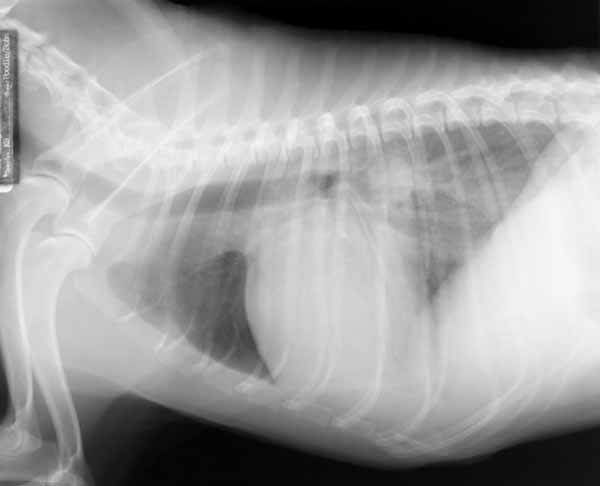
The radiographs show that the pulmonary edema had decreased but was still present. Consequently, Bingo was sent home with instructions to increase his furosemide dose to 25 mg q8 hours. Following this, his respiratory rate decreased to less than 30 breaths/minute and his coughing stopped. The owners were instructed to bring him back for another examination in three months or to contact us if his resting respiratory rate went above 30 breaths/minute again.
The primary controversial subject in this dog is whether or not to use digoxin. Because this dog had evidence of mild myocardial failure, administration of a positive inotropic agent may be indicated. As long as it is used judiciously and cautiously, there are no contraindications to the use of digoxin in this dog. However, echocardiographic and clinical follow-up of at least 15 dogs like this, either before and after starting digoxin or before and after stopping digoxin, has yet to reveal a positive change after starting digoxin or a negative change after stopping it. Consequently, digoxin was withheld from dogs with severe mitral regurgitation until they are refractory to other drugs. When dogs are refractory to furosemide and an ACE inhibitor, some dogs improve clinically with digoxin, though they are in the minority. Recent evidence suggests that digoxin is a moderately good diuretic, which is one possible explanation for the improvement in some dogs refractory to furosemide.
Second Follow-Up
The owner was contacted again 3 months after the last clinic visit. She reported that Bingo had died the week before. He had done well for the three months although they had to increase his Lasix dose to keep his respiratory rate under 30 breaths/minute. At the time he died his Lasix dose was 50 mg q8 hours (increased from 25 mg q8–12 hours). He died subacutely — he was fine when the owner got up in the morning, then within half an hour he became very dyspneic and progressed rapidly to the point that he had pulmonary edema fluid emanating from his nose. He passed away a short time later. Based on the acuteness of the clinical signs, the owner was told that he probably ruptured a chorda tendineae.