Case 7 — Two-Month Reexamination
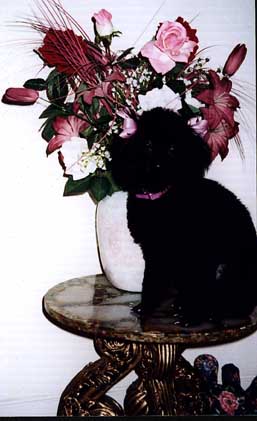
Cindy at the two-month follow-up (6 months of age).
Cindy was reexamined two months after the balloon valvuloplasty (6 months of age). She was clinically normal to the owner, who noticed no difference in activity between Cindy and her other toy poodle. She had doubled her weight from 2.2 to 4.5 kg. Whereas her packed cell volume was 68% at the time of the first examination, it was now 51%. An arterial blood gas revealed an arterial oxygen tension of 62 mmHg (previously 55 mmHg on 100% oxygen, and almost assuredly below 40 mmHg on room air at initial examination). Her pressure gradient across the pulmonic valve region was 64 mmHg. Based on these data, the owner was given a good prognosis and Cindy was sent home.
Summary from Medical Record
- Thoracic radiographs: No tracheal collapse noted, no abnormal lung patterns, and no significant changes in the size or shape of her heart compared to previous radiographs.
- ECG: Sinus rhythm; tall P waves at approximately 0.6 mV suggestive of enlarged RA; right axis shift (−140°); right bundle branch block (QRS complex approximately 90 msec in duration).
- Echocardiogram: Moderate pulmonic stenosis with a pressure gradient of 64 mmHg (velocity 4 m/s). Both membranes of the foramen ovale were again visualized. The right ventricle is slightly less hyperechoic than three months ago, although difficult to discern definitively since the entire heart has grown with the dog and is still quite bright. Mild tricuspid regurgitation. RVFW(d) = 0.8 cm, IVS(d) = 0.8 cm, LVEDD = 1.9 cm, LVESD = 1.2 cm, FS = 38%, LVFW(d) = 0.4 cm, Ao:LA normal.
- Saline contrast echocardiography: Mild right-to-left shunting at the atrial level.
- PCV: 51% (down from 68% in April), indicating less right-to-left shunting via the patent foramen ovale and therefore less hypoxemia as a stimulus for red cell production.
- Arterial blood gases: PaO2 = 63 mmHg, PaCO2 = 36 mmHg on room air. She is still not oxygenating well, indicating continued right-to-left shunting; however, the degree of hypoxemia is improved from the pre-operative value of ~40 mmHg and is more compatible with a normal lifestyle.
- Conclusion: The reduction in pulmonic stenosis gradient obtained via balloon valvuloplasty has been effective at improving Cindy’s oxygenation and decreasing her right-to-left shunting. Although a shunt still exists and she has evidence of moderate desaturation, her clinical signs have resolved and the owner reports normalcy. Her PS gradient is slightly higher than that obtained post-operatively — this more likely reflects increased flow through the valve rather than recurring stenosis. Should her gradient increase in the future, a second balloon dilation could be performed. Recheck recommended in one year.