Case 12 — Continuous Wave Doppler Tracings

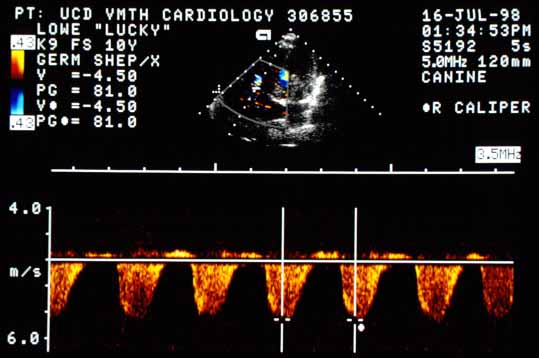
CW Doppler tracing of the tricuspid regurgitation jet showing a velocity of 4.5 m/s, corresponding to a pressure gradient of 81 mmHg across the tricuspid valve.
CW Doppler of the TR jet. Velocity: 4.5 m/s; pressure gradient: 81 mmHg. Assuming RA pressure of 10–15 mmHg (right heart failure), RV systolic pressure is ~95 mmHg.

Normal peak systolic RV pressure is 20–25 mmHg and normal RA pressure is <5 mmHg, giving a normal TR jet velocity of ~2 m/s. This dog’s velocity of 4.5 m/s translates into a gradient of 81 mmHg. Assuming RA pressure of ~14 mmHg (right heart failure), RV systolic pressure is ~95 mmHg.

CW Doppler tracing of the pulmonic regurgitation jet. Early diastolic velocity is ~3.9 m/s (PG 60 mmHg). Late diastolic velocity decreases to ~3 m/s (PG 36 mmHg). Estimated PA pressure: ~100 mmHg systolic, ~50 mmHg diastolic.
CW Doppler of the PI jet. Early diastolic velocity: ~3.9 m/s (PG = 60 mmHg; early diastolic PA pressure ~60 mmHg). Late diastolic velocity: ~3 m/s (PG = 36 mmHg). Estimated PA pressure: ~100/50 mmHg.
Quiz

1. Based on the information given with the first image, what is this dog’s calculated systolic right ventricular pressure?

2. Since RV and PA systolic pressures are essentially the same in this dog (no pulmonic stenosis), this means this dog has what?